











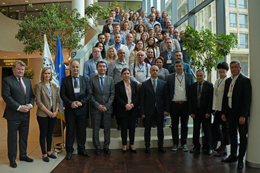
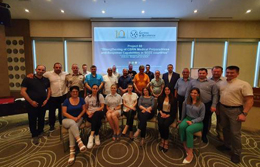
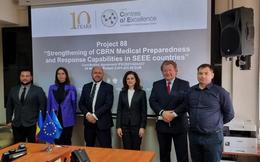
Training Center in The Republic of Armenia
Contacts
- The National Institute of Health of Armenia
- 14/10 Titogradyan st., 0087 Yerevan, Armenia
- Vigen Khachaturyan
- drvigen@gmail.com
Downloadable materials
 P88 HANDBOOK CBRNE SOPS GUIDELINES V1.0 (Armenian)
 Recent News
Armenia Strengthens CBRN Medical Decision-Making through National Table-Top Exercise and Ministry of Health Close-out Meeting
CBRN risk context
Hospitals, laboratories, and public facilities rely on chemicals and other hazardous materials to deliver essential services, yet legacy stockpiles and poorly documented substances can create serious public health and environmental risks. When unknown materials are disturbed, exposure can spread quickly through dust, vapours, surfaces, and even drainage systems. In such cases, rapid coordination between public health, emergency services, and hospitals is crucial to protect staff and patients, prevent secondary contamination, and manage public information responsibly.
Armenia tests senior-level coordination in a complex chemical discovery scenario
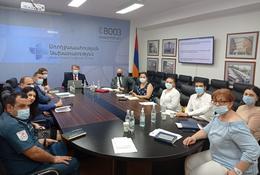
On 21–22 April 2026 in Yerevan, Armenia conducted a National CBRN Emergency Medicine Table-Top Exercise (TTX) focused on leadership decisions, inter-agency coordination, and health system readiness. The exercise scenario reflected a realistic challenge for many countries, the discovery of degraded, unlabelled chemical containers in an abandoned hospital storage area during maintenance work, followed by symptomatic exposure among workers and escalating public concern.
The scenario evolved through staged developments that required coordinated decisions. Participants addressed immediate actions for staff safety and scene control, the appropriate personal protective equipment for entry into a suspected contaminated area, and notification pathways for health and environmental authorities. Later injects introduced symptomatic casualties arriving at the emergency department, media enquiries, the absence of a certified hazardous waste operator, and suspicion that chemicals had entered the facility’s wastewater system, raising questions about isolation, evacuation thresholds, and longer-term containment responsibilities.
Participating organisations reflected the breadth of Armenia’s response system and included the Public Health Emergency Operations Center, the Environmental Hygiene Department, the Reference Laboratory Center, the First and Mobilization Preparation Department of the Ministry of Territorial Administration and Infrastructure, the Department of Monitoring of the Radiological, Chemical and Biological Situation of the Civil and Population Protection Department of the Emergency Service of the Ministry of Internal Affairs, civil protection and emergency divisions, the Yerevan Municipality Health Department, and several medical centres.
The action was implemented under EU CBRN CoE Project 88, “Strengthening of CBRN Medical Preparedness and Response Capabilities in South East and Eastern European countries,” funded by the European Union and implemented by the Science and Technology Centre in Ukraine (STCU), and is part of the EU CBRN Risk Mitigation Centres of Excellence Initiative.
What is different now: clearer roles, stronger coordination, and a sustainability pathway
A key added value of the TTX was that it moved beyond technical discussion and tested how senior decision-makers align actions across institutions when information is incomplete and pressure increases. By working through one shared scenario, participating entities clarified responsibilities for substance identification, risk assessment, protective measures, patient management, and public communication. The format also supported practical gap identification, particularly around inter-institutional coordination, access to specialised support for chemical identification and decontamination, and the challenges created when clean-up capacity is not immediately available.
Ministry of Health briefing connects the exercise to long-term national plans
Following the TTX, on 23 April 2026, a Ministry of Health close-out meeting was held to review achievements and discuss sustainability priorities. The session was hosted by the Ministry of Health of Armenia and included Mr Armen Melkonyan, Head of the International Relations Department at the Ministry of Health and Armenian Emergency Medical Team (EMT) lead, together with Ministry representatives and the Project 88 team. The discussion focused on maintaining and expanding national capacity after project completion, including planning future multi-agency exercises, integrating Project 88 training content into Armenia’s continuous professional development system for medical staff, and ensuring the Armenian Emergency Medical Team completes Project 88 training before the project end date.
The meeting also considered the value of regional coordination, noting the growing base of trained medical personnel across the wider region and proposing the development of a regional approach to mobilise trained staff in the event of a major CBRN incident.
Project background
EU CBRN CoE Project 88 supports partner countries in improving medical preparedness, response coordination, and sustainable training capacity for CBRN incidents through national-level training, exercises, and institutional cooperation.
Armenia Enhances CBRN Emergency Response with Specialized Medical Training
Armenia recently hosted its third National Chemical, Biological, Radiological, and Nuclear (CBRN) Emergency Medicine Training in a significant step towards bolstering its national security and healthcare infrastructure. The three-day event, held September 6-8, 2024, in Yerevan, marked a crucial milestone in the country's ongoing efforts to strengthen its CBRN emergency preparedness and response capabilities.
The training, organized by the Science and Technology Centre in Ukraine (STCU), showcased Armenia's growing self-sufficiency in CBRN preparedness. Master Trainers from the National Institute of Health of Armenia led the sessions, demonstrating the country's commitment to developing and utilizing local expertise. This approach aligns seamlessly with the EU CBRN CoE Project 88's objectives, which aim to enhance CBRN medical readiness across Southeastern and Eastern Europe.
The program catered to a wide array of professionals crucial to CBRN emergency response:
- First-line responders
- Hospital staff
- Emergency managers
- Medical professionals
Participants engaged in a curriculum that covered the spectrum of CBRN emergency medicine, from initial pre-hospital management to advanced medical procedures specific to CBRN incidents. This comprehensive approach ensures a well-rounded and coordinated response system in the face of potential CBRN threats.
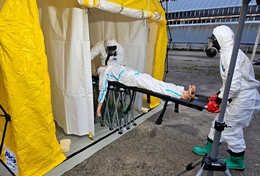
A key feature of the training was its emphasis on practical, hands-on experience. Through scenario-based simulations and interactive exercises, participants had the opportunity to apply theoretical knowledge to realistic situations. This practical approach not only reinforced learning but also promoted collaboration and knowledge sharing among professionals in the field.
The successful completion of this training represents more than just an educational milestone. It signifies Armenia's proactive stance in safeguarding its citizens against CBRN threats. Armenia has taken a significant step towards building a more resilient and secure nation by investing in local expertise and fostering a culture of preparedness.
As the country continues to develop its CBRN emergency response capabilities, this training serves as a testament to the power of local initiative and international cooperation in addressing global security challenges.
 Training P88
 Training P88
 Training P88
 Training P88
 Training P88
 Training P88
Armenia Successfully Completes Second National CBRN Emergency Medicine Training
From July 14 to 16, 2024, Armenia significantly improved its preparedness and response capabilities for Chemical, Biological, Radiological, and Nuclear (CBRN) emergencies with the successful conclusion of the second National CBRN Emergency Medicine Training in Yerevan. This event, organized by the Science and Technology Centre in Ukraine (STCU) and conducted by Armenia's CBRN Emergency Medicine Master Trainers, represents a pivotal achievement in empowering the country's frontline medical personnel.
This year, the training was led by Armenian Master Trainers from the National Institute of Health of Armenia, highlighting the commitment of Armenia's national training team to delivering high-quality instruction through local efforts. Such collaborations align with the EU CBRN CoE Project 88's objectives, which aim to strengthen CBRN medical preparedness and response capabilities in Southeastern and Eastern European countries.
The training equipped a diverse range of key personnel with essential skills and knowledge to respond effectively to CBRN medical emergencies. The curriculum was tailored to various target groups, including first-line responders, hospital staff, emergency managers, and medical professionals, covering topics from pre-hospital management to advanced medical procedures specific to CBRN incidents.
By addressing the specific needs of each target group, the training contributed significantly to building a robust and coordinated response system in Armenia. Hands-on exercises and scenario-based simulations provided participants with practical knowledge, fostering collaboration and knowledge exchange among CBRN emergency medicine professionals.
This training not only reinforced Armenia's readiness to handle CBRN emergencies but also showcased the effectiveness of local expertise in enhancing national capabilities.
Armenia Completes First National CBRN Emergency Medicine Training
Within the framework of the EU CBRN CoE P88 Project, which focuses on enhancing CBRN medical preparedness and response in South East and Eastern European (SEEE) countries, the Science and Technology Centre in Ukraine (STCU), in collaboration with the National Institute of Health of Armenia, successfully completed the First National CBRN Emergency Medicine Training. Held from May 29 to May 31, 2024, in Yerevan, Armenia, this training was supported by the European Commission's Foreign Policy Instrument, highlighting their commitment to improving preparedness and response capabilities in the region.
The training provided essential skills for various target groups: First-Line Responders focused on pre-hospital management, learning techniques for assessment, triage, decontamination, and patient stabilization during CBRN incidents. Second-line responders emphasized hospital management, enhancing healthcare professionals' abilities in patient care, decontamination, and coordination with first responders. Managers received training to improve strategic planning, resource allocation, coordination, and decision-making during CBRN incidents. Para-medical Personnel, including emergency medical technicians and paramedics, specialized in providing immediate care and support in pre-hospital settings. Medical Personnel, such as doctors, nurses, and specialists, received advanced training in diagnosis, treatment, and patient management in CBRN scenarios. This hands-on training aimed to establish a robust and coordinated response system in Armenia, enhancing practical knowledge through exercises and simulations. Further information on future training opportunities will be provided in the coming months.
 Training P88
 Training P88
 Training P88
 Training P88
 Training P88
 Training P88
 Training P88
 Training P88
 Training P88